Signed, Sealed, Slightly Resentful: The Office Card and the Art of Saying Nothing
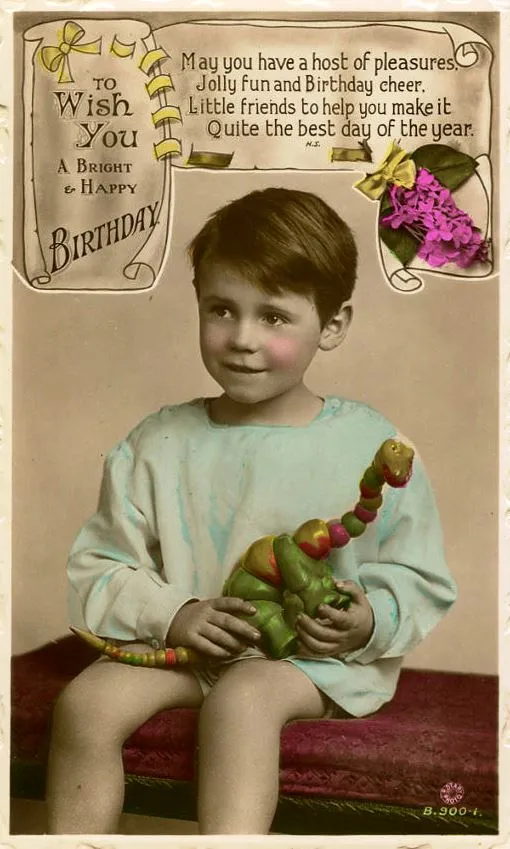
Photo: Unknown authorUnknown author, Public domain, via Wikimedia Commons
There is a particular sound an office makes when a card is doing the rounds: the soft slap of an envelope landing on a desk, followed by the sight of a biro on a length of string that has clearly been through a war. You know the drill. A sticky note says 'Please sign for Dave — last day Friday.' No context. No instructions. Just a name and a deadline and the collective weight of British politeness.
I have signed hundreds of these cards. I have written 'Best wishes' so many times it has lost all meaning. I have also, once, written something approaching a real sentence and watched the person after me read it, pause, and then write 'Best wishes' with the energy of a man defusing a bomb. That is the office card in a nutshell: a small rectangle of cardstock where sincerity goes to be managed.
The envelope economy
Every office has a card ecosystem, and it is rarely discussed. Someone buys the card. Usually it is the person who also remembers birthdays, organises the leaving collection and knows where the good scissors live. They choose from a rack at WHSmith or Clintons with the grim focus of a bomb-disposal expert. Humorous or respectful? Blank or printed? Does the card say 'Happy Birthday' or 'Another Year Older'? The wrong choice can set a tone for weeks.
Then there is the envelope. It travels. It acquires creases. It is signed by people who have never met the recipient and people who know them far too well. The biro is always slightly chewed. At some point, someone writes 'Please sign and pass on' on a Post-it note that will be ignored by at least two people, who will then sign it three days late and add 'Sorry — only just seen this!' as if the card has been lost at sea.
A taxonomy of signers
You can learn a lot about a workplace from the messages inside a card. There is the Minimalist, who writes 'Best wishes, P' and nothing else. There is the Novelist, who fills half the card with a reminiscence about a team-building day in 2019 and a joke that only three people understand. There is the Diplomat, who writes 'Wishing you all the best in your next chapter' — a phrase so beautifully empty it could be used in a hostage negotiation. And there is the Ghost, who signs only their first name in tiny letters, as if hoping the card will be lost before anyone reads it.
Then comes the Latecomer, who has to write over someone else's message because the card is full. They usually choose 'Good luck!' in enormous letters, which reads less like a blessing and more like a threat. And finally, the Auditor: the person who reads every message before signing, tuts quietly, and then writes something so neutral it could be carved on a bench.
The passive-aggressive novella
The office card is at its most dangerous when someone decides to be honest. Not openly honest — that would be madness — but passively honest. 'Good luck in your new role. You deserve it.' Is that warm? Is that a dig? It depends on the font. 'We'll manage somehow.' That is not a leaving message; that is a threat with a stamp on it. 'Get well soon — the team has really pulled together in your absence.' Translation: we have discovered you are not essential, and we are all quietly thrilled.
These messages are rarely planned. They are the result of someone being handed a card, a biro and thirty seconds to summarise a complex professional relationship. Under that pressure, the British brain reaches for the nearest available phrase: 'All the best.' 'Kind regards.' 'Sorry to see you go.' 'Sorry for your loss' — no, wait, wrong card. That happens too. The birthday card signed 'With deepest sympathy' is a classic of the genre.
The etiquette rules nobody wrote down
There are rules, of course. They are not written anywhere, but everyone knows them. Match the length of the previous message. Do not be the first to write if you have strong feelings. Never use the card to settle a score, air a grievance or make a joke about the stationery cupboard that only you find funny. If the recipient is leaving, do not mention how much calmer the office will be without them. If the recipient is ill, do not recommend a diet. If it is a birthday, do not write 'finally' before a number.
The safest message is a short, warm, slightly generic sentence. 'Happy birthday — hope you have a lovely day.' 'Best wishes for the future.' 'Thanks for everything — you'll be missed.' These are not creative, but they are safe. And in the office card economy, safe is the whole point. The card is not a document of genuine feeling; it is a ceasefire in cardboard form.
How to write a card that won't start a cold war by the kettle
First, read the room. If the card is for someone popular, a short warm message is fine. If the card is for someone divisive, a short warm message is essential. Second, avoid specifics. 'Good luck with the move' is fine. 'Good luck with the move — I could never live there' is not. Third, never mention a project that went badly, a meeting that went long or a Christmas party that went sideways. The card is not a debrief.
Fourth, sign legibly but not too legibly. You want to be identifiable as a decent person, not as the author of a passive-aggressive novella. Fifth, if you are unsure, write 'Best wishes' and move on. It has survived decades of office politics for a reason. It is the plain crisps of card messages: nobody's favourite, nobody's enemy.
Finally, remember that the card will be read by everyone before it reaches the recipient. It is a public performance of private sentiment. The person who buys it, the person who passes it round, the person who writes 'Please sign' on a sticky note — they are all engaged in a small act of collective diplomacy. The card is not really for Dave. It is for the rest of us, a way of saying: we are a team, we are polite, and we will not be discussing anything real until at least February.
So sign it. Write 'Best wishes'. Pass it on. And if you must be honest, save it for the leaving do, after the third drink, when everyone has stopped reading the card and started arguing about the taxi.