A Roast of Several Pieces: Sunday Lunch, Reconstructed From Clippings
There is a particular kind of optimism that arrives on a Sunday morning when you have a pair of scissors, a Pritt Stick and a stack of magazines from a car boot sale. It is the optimism of the collage-maker: the belief that fragments can become a whole. I had decided to cook a full British roast dinner using only recipe clippings. No cookbook. No website. No quiet glance at my mother's handwritten notes. Just paper, glue and the sort of confidence that usually precedes a small kitchen fire.
The brief was simple. Chicken, roast potatoes, Yorkshire puddings, vegetables, gravy. The execution was less simple. The clippings had come from magazines spanning roughly two decades, which meant they were not so much a recipe as a committee meeting of dead food writers, each one convinced that their oven temperature was the only oven temperature. One fragment insisted on 220°C fan. Another said 200°C conventional. A third, yellowed and clearly from a different era, said gas mark 7 and 'do not open the door, whatever you hear'. I pasted them onto a sheet of A3 in roughly the order I thought a roast should happen, which is how I ended up with the stuffing instructions in the middle of the gravy section and a note about 'resting time' Sellotaped to the kettle.
The Yorkshire Pudding Problem
The first real hostage situation involved the Yorkshire puddings. I had three clippings. The first said to rest the batter for thirty minutes. The second said to use it immediately, 'while the energy is still in the eggs'. The third, which looked like it had been cut from a magazine in the late nineties, said to chill it overnight. It was Sunday morning. Overnight was not available. I made a executive decision to rest it for forty minutes and then apologise to it.
What none of the clippings mentioned was the actual quantity of flour. One said 'enough'. One said 'a generous handful'. The third said '175g, but you'll know'. I did not know. I stood in the kitchen with a mug of tea, weighing flour and wondering whether 'you'll know' was a threat. In the end I used a ratio I remembered from somewhere, which is the cooking equivalent of guessing a password and hoping the account doesn't lock.
The puddings went into the oven at a temperature I had averaged from three contradictory instructions, which is not how averages work. They rose, then sulked, then rose again. By the time I opened the door they looked like small, pale hats for people with very specific heads. Not bad. Not right. Held together by hope and hot fat.
Gravy Diplomacy
The gravy was where the clippings truly turned on me. I had a fragment that began 'First, make a roux' and ended mid-sentence at the bottom of the page. I had another that said 'simply use the juices' without saying which juices, from what, or whether I was supposed to have captured them in some kind of trap. A third clipping was mostly an advert for stock cubes, with a recipe printed around the edges like a ransom note.
I negotiated. I offered the gravy a deal: I would use the chicken juices, a spoon of flour, and a splash of whatever was open in the fridge. In return, it would not taste like regret. The gravy accepted. It was thin, then thick, then thin again. I added salt. It became salty. I added water. It became watery. I added a second stock cube and it became, suddenly and unexpectedly, quite good. This is not a technique I would recommend to anyone, but it is a technique that worked.
The Burnt Hostage
Every hostage situation needs a casualty. Mine was a single Yorkshire pudding that I left in the oven while I dealt with the gravy. It came out dark brown, rigid, and faintly accusatory. I placed it on the side of the plate like a small burnt monument to my own optimism. The others were fine. This one had been held to ransom by my attention span and lost.
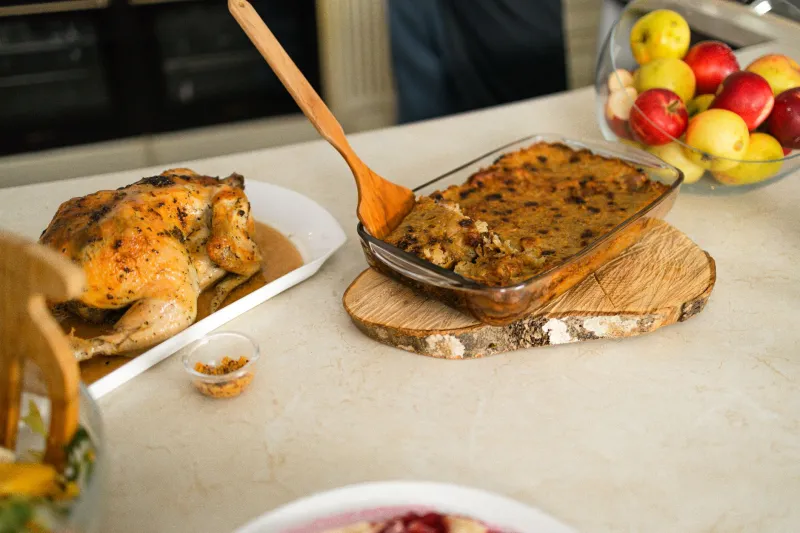
The chicken, surprisingly, was excellent. The clipping for that had been straightforward: 'Roast until cooked.' I roasted it until cooked. The potatoes had been instructed to 'parboil, shake, and roast in hot fat until golden', which is the most honest recipe instruction I have ever pasted to a sheet of paper. They were golden. The carrots were from a clipping that said 'glaze with honey and butter' and nothing else, which I did, and which was correct.
What the Collage Taught Me
Cooking from clippings is not efficient. It is not reliable. It is, however, a strange and satisfying way to spend a Sunday. You become a detective in your own kitchen, reading between the lines of people who assumed you had the rest of the page. You learn that 'continue as before' is meaningless when 'before' is stuck to the back of a furniture advert. You learn that oven temperatures are suggestions, and that gravy is a negotiation.
The roast was not held to ransom. I was. Held to ransom by missing steps and contradictory instructions, and the quiet stubbornness of following a recipe that was never meant to exist. But the plate was full, the gravy was acceptable, and the burnt Yorkshire pudding stayed on the side like a reminder: next time, use one magazine.
I have kept the A3 sheet. It is pinned to the kitchen wall, a collage of other people's Sundays. I might try it again. I might not. Either way, the scissors are still in the drawer, and there is always another car boot sale.