Might Need That One Day: An Inventory of My Shed, Jar by Jar
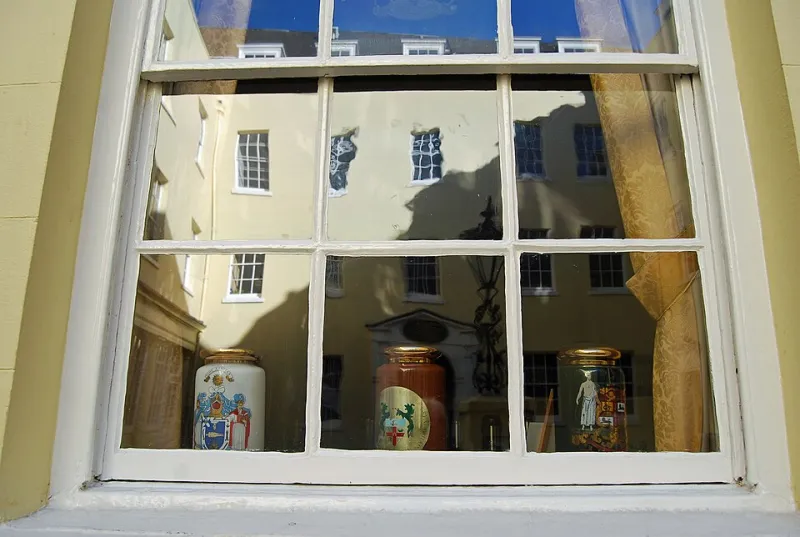
Photo: maggie jones., Public domain, via Wikimedia Commons
The shed is six foot by eight and it has a smell all of its own: creosote, old grass seed and the faint sweetness of a petrol can that has been empty since about 2011. It is not a workshop. It is a holding bay.
This autumn I decided to do something about the jars. Not to throw them out — I'm not a maniac — but to catalogue them. Properly. An inventory, with headings. What follows is what I found, and what other people told me about theirs.
The Coffee Jar Problem
The archetypal container is a 200g Nescafé jar, screw-top, with a label gone soft at the edges. Inside: forty-one screws. Maybe nine of them match. Two have a head shape I cannot name. One is brass and looks like it belongs to a boat.
I own six such jars. My father had four. His father had a tobacco tin, which is a different civic tradition entirely and one I'm not qualified to comment on.
Nobody knows where the contents came from. That's the point. The jar is not a storage solution; it's an act of faith.
A Rough Taxonomy
After two weekends and a cheap set of label stickers, I've concluded there are five species of shed jar in Britain.
The Survivor. A jam jar of rawl plugs in three sizes, all faded, none quite the right diameter for any hole you will ever drill. Requires a masonry bit and a small prayer.
The Inherited. Came with the house, or with a dead relative, or from the back of a garage you cleared in 2019. Contents partially rusted into a single mass. Cannot be opened without violence.
The Specialist. A tiny jar of watch screws or fishing swivels or something for a sewing machine made before decimalisation. Kept because the day you need it, nothing else will do, and that day has not yet come.
The Liar. Lid says SANDING DISCS. Contains three washers and a dead spider.
The Mystery. No label. No recognisable contents. Slightly warm to the touch in a way I've chosen not to investigate.
What the Repair People Said
I took the jars — or photographs of them, I'm not carrying six jars across town — to a repair café that runs out of a church hall on the second Saturday of the month. Two volunteers, a kettle and a queue of people holding kettles.
One of them, Priya, has been fixing small appliances there for four years. She said the jars are the whole reason the café works. "Somebody brings in a lamp with a missing switch. We haven't got that switch. But Ron's got a jar. And in Ron's jar is a switch off a heater that died in 1998, and it fits, near enough."
Ron, seventy-one, was sitting at the next table with a soldering iron and the expression of a man who has been vindicated for four decades. He told me he has never once regretted keeping anything, and then, after a pause, admitted he regretted keeping a lawnmower engine in the bath for a fortnight in 2003.
Might Need That One Day
The phrase is a clause in a contract you sign with your future self, and it's always the same contract. You are betting that the world will eventually require a 3-inch coach bolt. The world rarely does. But the betting is not really about hardware.
There's a quiet optimism in a jar of screws that I find quite moving. It assumes there will be a future in which things can be mended, in which you are still the sort of person who gets a screwdriver out, in which the object in front of you is worth an hour rather than a trip to the shop.
A skip says: this is finished. A jar says: not yet.
The 2026 Repair Revival
We're in the middle of a genuine revival, and not just the wistful kind. Repair cafés have gone from a niche to a Saturday fixture in most towns. Right-to-repair rules have made manufacturers publish spare parts and manuals they'd rather have buried. High street chains run mending workshops. There's a shop near me that will rewire a lamp for the price of two coffees and a chat about the weather.
Some of this is money. When replacing something costs what it costs in 2026, fixing it suddenly looks like common sense rather than eccentricity. Some of it is the landfill guilt we've all absorbed. And some of it, honestly, is that people have rediscovered the specific satisfaction of a thing working again because of their own hands.
The jar is the infrastructure of all that. It's the seed bank of the repair economy — a distributed, unindexed, mildly chaotic spare parts warehouse running out of eleven million gardens.
The Numbers, Such As They Are
My final tally: six jars, two tins, one ice cream tub, and a small Fortnum's biscuit tin that I have decided not to open on the grounds that it was sealed with tape and my nerve failed.
Recognisable items: 214.
Items I could name with confidence: 98.
Items I used in the following fortnight: 3.
Items I threw away: none, obviously. I'm not an animal.
The Rule I'm Not Going to Follow
Everyone who writes about decluttering eventually reaches the bit where they tell you to be ruthless. Bin the jar. If you haven't needed it in two years, you won't need it. Buy the right screw new for 40p.
It's sound advice and I'm ignoring it.
The jar is not an efficiency problem to be solved. It's a small, weather-beaten monument to the belief that things can be put back together, and that the person who does the putting is you. Also, the stool I bought at a car boot sale in the spring wobbles, and I know exactly which jar the fix is in.
Probably. Worth a look.