Three Quid and a Handshake: What a Wet Saturday Field Taught Me About Value
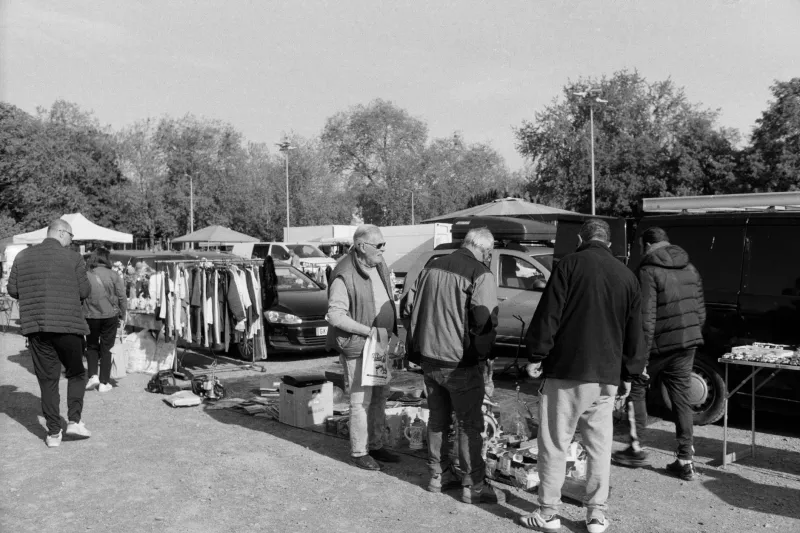
The alarm goes off at ten past six on a Saturday, which is a time I normally reserve for airports and hospital appointments. But there's a field behind a leisure centre twenty minutes up the road, and by seven it will be full of hatchbacks with their boots open and men in fleeces unfolding pasting tables with the grim efficiency of a military operation.
I have come for a stool. Specifically, a small wooden one — the sort that lives in a workshop and holds a radio. I have also come, though I wouldn't have admitted it at the time, to be told no by strangers in a car park and to enjoy it.
The Entry Fee and the Early Rush
Two pounds to walk in as a buyer. Sellers paid twelve for the pitch, and most of them have been here since half six, standing in the dark with a torch, arguing about whether the trestle goes at the front. There's a smell of damp canvas and fried onions, which shouldn't work at 7am and somehow does.
The professionals — and I use the word generously — move at a half-run, scanning for the telltale signs: a box of tools, a stack of vinyl, anything with a plug on it. The rest of us shuffle. I shuffle with a tea in one hand and a vague sense of purpose in the other.
Nobody Pays the Asking Price (And Everyone Knows It)
Here's the thing that outsiders never grasp about a British car boot: the price is not a price. It's an opening bid. A declaration of intent. It's the seller saying I have a number in mind and the buyer saying so do I, and mine is smaller and cheekier.
A man wanted a tenner for a pair of lamps with shades the colour of old margarine. I said four. He looked at me like I'd questioned his parentage. I looked at him like he'd insulted my grandmother. Two grown adults, both entirely aware that these lamps are worth about six pounds to the right person, performing a small opera of wounded dignity.
We settled at six. He put the money in a Tupperware and said, with real warmth, "Enjoy them, mate." This is the whole ritual in miniature.
The £1 Opener and Other Sacred Rites
The one-pound opening offer is not an insult. It's a handshake. It says: I know the game, you know the game, let's play it. The correct response is not fury but a theatrical wince, a slow shake of the head, and a counter so far above your own floor that the negotiation has to meet somewhere in the middle like two tired dogs.
Do not, under any circumstances, open with the asking price. You might as well turn up to a wedding in a dressing gown.
Then there's the Walk-Away — half performance, half genuine. You thank them, you turn, you take four steps. If they call you back, the item was priced to move. If they don't, you've learned the seller's actual floor and you can come back in twenty minutes with a different face and a bundle offer.
The Bundle Close
Bundling is the advanced move. You gather three items of wildly unequal value, present them as a job lot, and propose a sum whose arithmetic is deliberately hard to follow. A toolbox, a hose reel and a book about ferrets. Nine pounds. The seller does sums in their head, gets a different answer, and says ten. You say "go on then" in a tone that suggests you're the one doing the favour.
I once watched a woman acquire an entire garden bench, a watering can and a box of terracotta pots for eleven pounds using nothing but a withering look and the phrase "it's got woodworm, love."
What the Contactless Reader Did to the Theatre
In 2026 you'll find card readers on maybe a third of the tables, propped against a biscuit tin, and they've changed the rhythm of the thing. Cash changed hands fast and slightly sheepishly; a card reader has a little screen and a boop and somehow the drama goes out of it.
The best sellers still run on notes and coins. Not because they're luddites — well, some of them are — but because a fiver in the hand is a fiver, and nobody in a field with one bar of signal wants to troubleshoot your bank.
What hasn't changed is that everyone is now aware of what things go for online. The man who wants forty quid for a chipped Pyrex jug because he's seen one on an auction site has rather missed the point. The field isn't a shop. The discount is for the pleasure of turning up.
The Stool
I found it at ten past nine. Oak, faintly wobbling, on a table next to a box of mismatched sockets. The seller wanted eight.
I said three. He laughed, genuinely, and asked whether I'd like his car thrown in. I said I'd take the stool for three and he could keep the car. Somewhere in the next ninety seconds we did the whole dance — the wince, the counter at seven, my considered silence, the walk-away, the call-back.
Three pounds.
He helped me carry it to the boot. On the way he told me he'd had it since 1994, that his wife had made him choose between it and a set of shelves, and that he'd chosen badly and was now paying for it. I said I'd look after it. He said, "Don't be soft," and shook my hand anyway.
What the Field Is Actually Selling
A stool, technically. But also: a morning out, a bit of theatre with strangers, and permission to be a bit cheeky with people you'll never see again. In a year when nearly everything is priced by an algorithm and paid for by a thumbprint, there's something oddly humane about standing in a wet field and agreeing, face to face, that a thing is worth three pounds.
Not four. Not eight. Three — because that's the number two people landed on, out loud, together.
I've used the stool every day since. It wobbles. I've decided I like that.